# 磁盘调度算法有什么?
# 简要回答
磁盘调度算法是操作系统优化磁盘I/O性能的核心技术,通过合理安排磁头移动顺序减少寻道时间。
主要算法包括:先来先服务(FCFS)、最短寻道时间优先(SSTF)、扫描算法(SCAN)、循环扫描算法(C-SCAN)、LOOK算法、C-LOOK算法。
评估指标包括平均寻道长度、响应时间和吞吐量。
# 专业回答
磁盘访问时间由三部分组成:
寻道时间:磁头移动到目标柱面(≈5-15ms)
旋转延迟:磁盘旋转到目标扇区(≈4-8ms)
传输时间:读写数据时间(相对很短)
磁盘调度算法主要优化寻道时间,因为它是主要瓶颈。
假设一个典型硬盘有1000个柱面(0-999),磁头初始位置在不同算法下移动方式不同。
七大算法详解
- 先来先服务(FCFS, First Come First Serve)
原理:按照请求到达顺序服务,磁头按请求顺序移动。
特点: 公平性最好,实现最简单, 性能最差,平均寻道距离最大, 磁头可能来回震荡,产生"抖动"
- 最短寻道时间优先(SSTF, Shortest Seek Time First)
原理:每次选择离当前磁头位置最近的请求服务。
特点: 贪心算法,局部最优, 比FCFS性能好,平均寻道距离小, 可能产生"饥饿":边缘请求长时间得不到,服务,响应时间波动大
- 扫描算法(SCAN,电梯算法)
原理:磁头单向移动,到尽头后反向,像电梯上下运行。
工作方式: 磁头从一端开始向另一端移动, 途中服务所有请求, 到达另一端后反向移动, 重复此过程
特点: 无饥饿问题,公平性好 平均寻道距离介于FCFS和SSTF之间 边缘请求等待时间较长(磁头必须到尽头)
变体: LOOK算法:到最远请求就反向,不必到尽头, C-SCAN:单向服务,返回时不服务请求,
- 循环扫描算法(C-SCAN, Circular SCAN)
原理:磁头单向移动,到尽头后快速返回起点(不服务请求),重新开始。
特点: 等待时间更均匀, 对边缘请求更公平(不会长时间等待), 牺牲一定性能换取公平性
- N步扫描算法(N-Step-SCAN)
原理:将请求队列分成N个子队列,每个队列使用SCAN算法。
特点: 减少磁臂粘着(arm stickiness), 折中响应时间和吞吐量, 实现较复杂
- FSCAN算法
原理:将请求分为两个队列,一个当前服务队列使用SCAN,新请求进入另一个队列。
特点: 避免新请求影响当前扫描 减少响应时间波动
# 代码示例
#include <iostream>
#include <vector>
#include <algorithm>
#include <cmath>
#include <queue>
#include <iomanip>
#include <limits>

using namespace std;

// 磁盘调度算法基类
class DiskScheduler {
protected:
    vector<int> requests;    // 请求队列
    int head;                // 当前磁头位置
    int maxCylinder;         // 最大柱面号

public:
    DiskScheduler(vector<int> req, int start, int max = 199)
        : requests(req), head(start), maxCylinder(max) {}

    virtual void schedule() = 0;
    virtual string getName() = 0;

    // 计算平均寻道长度
    double calculateAvgSeek(const vector<int>& order) {
        if (order.empty()) return 0;

        int totalSeek = 0;
        int current = head;

        cout << "调度顺序: " << current;
        for (int pos : order) {
            totalSeek += abs(pos - current);
            cout << " -> " << pos;
            current = pos;
        }
        cout << endl;

        double avg = (double)totalSeek / order.size();
        cout << "总寻道长度: " << totalSeek
             << ", 平均寻道长度: " << fixed << setprecision(2) << avg << endl;
        return avg;
    }
};

// 1. 先来先服务算法
class FCFS : public DiskScheduler {
public:
    FCFS(vector<int> req, int start, int max = 199)
        : DiskScheduler(req, start, max) {}

    string getName() override { return "FCFS (先来先服务)"; }

    void schedule() override {
        cout << "\n=== " << getName() << " ===" << endl;
        cout << "初始磁头位置: " << head << endl;
        cout << "请求序列: ";
        for (int r : requests) cout << r << " ";
        cout << endl;

        // 直接按请求顺序服务
        calculateAvgSeek(requests);
    }
};

// 2. 最短寻道时间优先算法
class SSTF : public DiskScheduler {
public:
    SSTF(vector<int> req, int start, int max = 199)
        : DiskScheduler(req, start, max) {}

    string getName() override { return "SSTF (最短寻道优先)"; }

    void schedule() override {
        cout << "\n=== " << getName() << " ===" << endl;
        cout << "初始磁头位置: " << head << endl;
        cout << "请求序列: ";
        for (int r : requests) cout << r << " ";
        cout << endl;

        vector<int> temp = requests;
        vector<int> order;
        int current = head;

        while (!temp.empty()) {
            // 找到距离当前位置最近的请求
            auto closest = min_element(temp.begin(), temp.end(),
                [current](int a, int b) {
                    return abs(a - current) < abs(b - current);
                });

            order.push_back(*closest);
            current = *closest;
            temp.erase(closest);
        }

        calculateAvgSeek(order);
    }
};

// 3. SCAN算法(电梯算法)
class SCAN : public DiskScheduler {
private:
    bool direction;  // true: 向外(增大), false: 向内(减小)

public:
    SCAN(vector<int> req, int start, bool dir = true, int max = 199)
        : DiskScheduler(req, start, max), direction(dir) {}

    string getName() override {
        return string("SCAN (扫描算法) - ") +
               (direction ? "向外移动" : "向内移动");
    }

    void schedule() override {
        cout << "\n=== " << getName() << " ===" << endl;
        cout << "初始磁头位置: " << head << endl;
        cout << "请求序列: ";
        for (int r : requests) cout << r << " ";
        cout << endl;

        vector<int> left, right;
        vector<int> order;

        // 分离左右请求
        for (int req : requests) {
            if (req < head) left.push_back(req);
            if (req > head) right.push_back(req);
        }

        // 排序
        sort(left.begin(), left.end(), greater<int>());  // 降序
        sort(right.begin(), right.end());                // 升序

        int current = head;

        if (direction) {  // 向外移动
            // 先服务右侧(增大方向)
            for (int r : right) {
                order.push_back(r);
                current = r;
            }

            // 到尽头后反向
            if (current != maxCylinder) {
                order.push_back(maxCylinder);
                current = maxCylinder;
            }

            // 服务左侧
            for (int r : left) {
                order.push_back(r);
                current = r;
            }
        } else {  // 向内移动
            // 先服务左侧(减小方向)
            for (int r : left) {
                order.push_back(r);
                current = r;
            }

            // 到尽头后反向
            if (current != 0) {
                order.push_back(0);
                current = 0;
            }

            // 服务右侧
            for (int r : right) {
                order.push_back(r);
                current = r;
            }
        }

        calculateAvgSeek(order);
    }
};

// 4. C-SCAN算法(循环扫描)
class CSCAN : public DiskScheduler {
public:
    CSCAN(vector<int> req, int start, int max = 199)
        : DiskScheduler(req, start, max) {}

    string getName() override { return "C-SCAN (循环扫描)"; }

    void schedule() override {
        cout << "\n=== " << getName() << " ===" << endl;
        cout << "初始磁头位置: " << head << endl;
        cout << "请求序列: ";
        for (int r : requests) cout << r << " ";
        cout << endl;

        vector<int> left, right;
        vector<int> order;

        // 分离左右请求
        for (int req : requests) {
            if (req < head) left.push_back(req);
            if (req >= head) right.push_back(req);
        }

        // 排序
        sort(left.begin(), left.end());      // 升序
        sort(right.begin(), right.end());    // 升序

        // 先服务右侧(当前及以后)
        for (int r : right) {
            if (r != head || order.empty()) {  // 避免重复添加当前位置
                order.push_back(r);
            }
        }

        // 快速返回到起点
        if (!order.empty() && order.back() != maxCylinder) {
            order.push_back(maxCylinder);
        }

        // 回到0柱面(快速返回,不服务请求)
        if (!left.empty()) {
            order.push_back(0);
        }

        // 服务左侧请求
        for (int r : left) {
            order.push_back(r);
        }

        calculateAvgSeek(order);
    }
};

// 5. LOOK算法(改进的SCAN)
class LOOK : public DiskScheduler {
private:
    bool direction;

public:
    LOOK(vector<int> req, int start, bool dir = true, int max = 199)
        : DiskScheduler(req, start, max), direction(dir) {}

    string getName() override {
        return string("LOOK算法 - ") +
               (direction ? "向外移动" : "向内移动");
    }

    void schedule() override {
        cout << "\n=== " << getName() << " ===" << endl;
        cout << "初始磁头位置: " << head << endl;
        cout << "请求序列: ";
        for (int r : requests) cout << r << " ";
        cout << endl;

        vector<int> left, right;
        vector<int> order;

        // 分离左右请求
        for (int req : requests) {
            if (req < head) left.push_back(req);
            if (req > head) right.push_back(req);
        }

        // 排序
        sort(left.begin(), left.end(), greater<int>());  // 降序
        sort(right.begin(), right.end());                // 升序

        if (direction) {  // 向外移动
            // 服务右侧请求
            for (int r : right) {
                order.push_back(r);
            }

            // 反向服务左侧请求
            for (int r : left) {
                order.push_back(r);
            }
        } else {  // 向内移动
            // 服务左侧请求
            for (int r : left) {
                order.push_back(r);
            }

            // 反向服务右侧请求
            for (int r : right) {
                order.push_back(r);
            }
        }

        calculateAvgSeek(order);
    }
};

// 6. C-LOOK算法(改进的C-SCAN)
class CLOOK : public DiskScheduler {
public:
    CLOOK(vector<int> req, int start, int max = 199)
        : DiskScheduler(req, start, max) {}

    string getName() override { return "C-LOOK算法"; }

    void schedule() override {
        cout << "\n=== " << getName() << " ===" << endl;
        cout << "初始磁头位置: " << head << endl;
        cout << "请求序列: ";
        for (int r : requests) cout << r << " ";
        cout << endl;

        vector<int> left, right;
        vector<int> order;

        // 分离左右请求
        for (int req : requests) {
            if (req < head) left.push_back(req);
            if (req >= head) right.push_back(req);
        }

        // 排序
        sort(left.begin(), left.end());      // 升序
        sort(right.begin(), right.end());    // 升序

        // 服务右侧请求
        for (int r : right) {
            if (r != head || order.empty()) {  // 避免重复添加当前位置
                order.push_back(r);
            }
        }

        // 快速返回到左侧最小请求处(不经过中间柱面)
        if (!left.empty()) {
            // 直接跳到最小请求处
            order.push_back(left.front());

            // 服务剩余左侧请求
            for (size_t i = 1; i < left.size(); i++) {
                order.push_back(left[i]);
            }
        }

        calculateAvgSeek(order);
    }
};

// 测试函数
void testAllAlgorithms() {
    // 测试数据
    vector<int> requests = {98, 183, 37, 122, 14, 124, 65, 67};
    int initialHead = 53;
    int maxCylinder = 199;

    cout << "===== 磁盘调度算法对比 =====" << endl;
    cout << "初始磁头位置: " << initialHead << endl;
    cout << "请求序列: ";
    for (int r : requests) cout << r << " ";
    cout << "\n最大柱面号: " << maxCylinder << endl;

    // 测试各种算法
    vector<DiskScheduler*> schedulers;

    schedulers.push_back(new FCFS(requests, initialHead, maxCylinder));
    schedulers.push_back(new SSTF(requests, initialHead, maxCylinder));
    schedulers.push_back(new SCAN(requests, initialHead, true, maxCylinder));
    schedulers.push_back(new CSCAN(requests, initialHead, maxCylinder));
    schedulers.push_back(new LOOK(requests, initialHead, true, maxCylinder));
    schedulers.push_back(new CLOOK(requests, initialHead, maxCylinder));

    vector<double> results;

    for (auto scheduler : schedulers) {
        scheduler->schedule();
        cout << endl;
        delete scheduler;
    }
}

// 交互式演示
void interactiveDemo() {
    cout << "===== 磁盘调度算法交互演示 =====" << endl;

    int maxCylinder, headPos, n;

    cout << "请输入最大柱面号(默认199): ";
    string input;
    getline(cin, input);
    maxCylinder = input.empty() ? 199 : stoi(input);

    cout << "请输入初始磁头位置: ";
    cin >> headPos;

    cout << "请输入请求数量: ";
    cin >> n;

    vector<int> requests;
    cout << "请输入" << n << "个请求柱面号(0-" << maxCylinder << "):" << endl;
    for (int i = 0; i < n; i++) {
        int req;
        cin >> req;
        if (req < 0 || req > maxCylinder) {
            cout << "无效输入,请重新输入: ";
            i--;
            continue;
        }
        requests.push_back(req);
    }

    cout << "\n选择算法:" << endl;
    cout << "1. FCFS (先来先服务)" << endl;
    cout << "2. SSTF (最短寻道优先)" << endl;
    cout << "3. SCAN (扫描算法)" << endl;
    cout << "4. C-SCAN (循环扫描)" << endl;
    cout << "5. LOOK算法" << endl;
    cout << "6. C-LOOK算法" << endl;
    cout << "7. 全部测试" << endl;
    cout << "请选择(1-7): ";

    int choice;
    cin >> choice;

    DiskScheduler* scheduler = nullptr;

    switch (choice) {
        case 1:
            scheduler = new FCFS(requests, headPos, maxCylinder);
            break;
        case 2:
            scheduler = new SSTF(requests, headPos, maxCylinder);
            break;
        case 3:
            scheduler = new SCAN(requests, headPos, true, maxCylinder);
            break;
        case 4:
            scheduler = new CSCAN(requests, headPos, maxCylinder);
            break;
        case 5:
            scheduler = new LOOK(requests, headPos, true, maxCylinder);
            break;
        case 6:
            scheduler = new CLOOK(requests, headPos, maxCylinder);
            break;
        case 7:
            testAllAlgorithms();
            return;
        default:
            cout << "无效选择!" << endl;
            return;
    }

    if (scheduler) {
        scheduler->schedule();
        delete scheduler;
    }
}

int main() {
    int choice;
    cout << "磁盘调度算法演示程序" << endl;
    cout << "1. 使用预设数据测试所有算法" << endl;
    cout << "2. 交互式演示" << endl;
    cout << "请选择(1-2): ";
    cin >> choice;

    if (choice == 1) {
        testAllAlgorithms();
    } else if (choice == 2) {
        interactiveDemo();
    } else {
        cout << "无效选择!" << endl;
    }

    return 0;
}
2
3
4
5
6
7
8
9
10
11
12
13
14
15
16
17
18
19
20
21
22
23
24
25
26
27
28
29
30
31
32
33
34
35
36
37
38
39
40
41
42
43
44
45
46
47
48
49
50
51
52
53
54
55
56
57
58
59
60
61
62
63
64
65
66
67
68
69
70
71
72
73
74
75
76
77
78
79
80
81
82
83
84
85
86
87
88
89
90
91
92
93
94
95
96
97
98
99
100
101
102
103
104
105
106
107
108
109
110
111
112
113
114
115
116
117
118
119
120
121
122
123
124
125
126
127
128
129
130
131
132
133
134
135
136
137
138
139
140
141
142
143
144
145
146
147
148
149
150
151
152
153
154
155
156
157
158
159
160
161
162
163
164
165
166
167
168
169
170
171
172
173
174
175
176
177
178
179
180
181
182
183
184
185
186
187
188
189
190
191
192
193
194
195
196
197
198
199
200
201
202
203
204
205
206
207
208
209
210
211
212
213
214
215
216
217
218
219
220
221
222
223
224
225
226
227
228
229
230
231
232
233
234
235
236
237
238
239
240
241
242
243
244
245
246
247
248
249
250
251
252
253
254
255
256
257
258
259
260
261
262
263
264
265
266
267
268
269
270
271
272
273
274
275
276
277
278
279
280
281
282
283
284
285
286
287
288
289
290
291
292
293
294
295
296
297
298
299
300
301
302
303
304
305
306
307
308
309
310
311
312
313
314
315
316
317
318
319
320
321
322
323
324
325
326
327
328
329
330
331
332
333
334
335
336
337
338
339
340
341
342
343
344
345
346
347
348
349
350
351
352
353
354
355
356
357
358
359
360
361
362
363
364
365
366
367
368
369
370
371
372
373
374
375
376
377
378
379
380
381
382
383
384
385
386
387
388
389
390
391
392
393
394
395
396
397
398
399
400
401
402
403
404
405
406
407
408
409
410
411
412
413
414
415
416
417
418
419
420
421
422
423
424
425
426
427
428
429
430
431
432
433
434
435
436
437
438
439
440
441
442
443
444
445
446
447
448
449
450
451
452
453
454
455
456
457
458
459
460
461
462
463
464
465
466
467
468
469
470
471
# 知识拓展
现代磁盘技术影响
固态硬盘(SSD): 无机械部件,寻道时间几乎为0, 调度算法重要性降低, 但仍有优化空间(并发请求、垃圾回收)
多磁头磁盘: 多个磁头可同时移动, 更复杂的调度算法, 区域位记录(ZBR)技术
RAID阵列: 多个磁盘并行工作, 需要跨磁盘调度, 负载均衡和数据分布
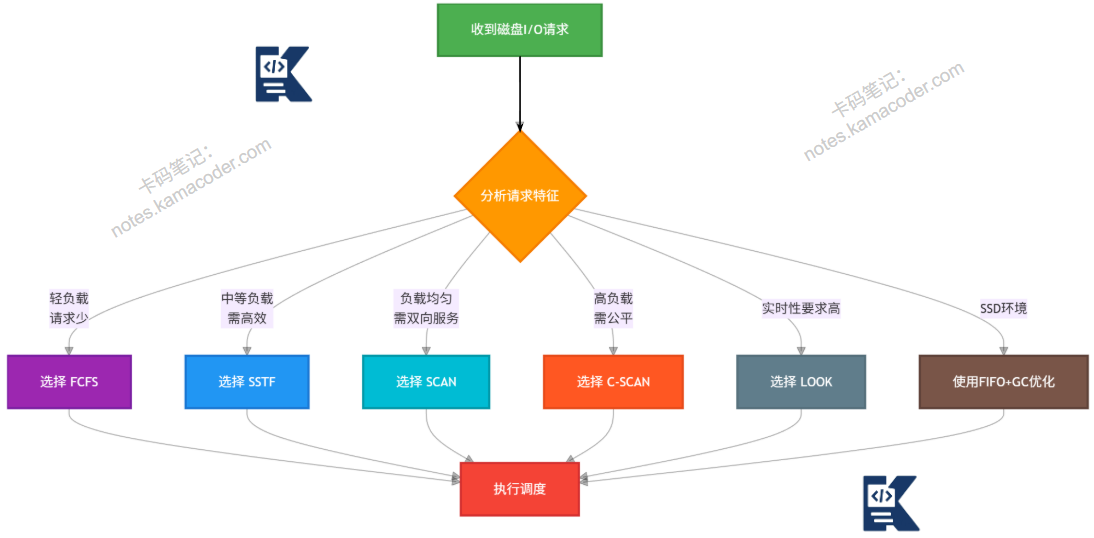
- 适用场景
不同算法的适用场景
FCFS(先来先服务): 负载很轻的系统, SSD固态硬盘(寻道时间不重要), 测试和基准对比, 简单嵌入式系统
SSTF(最短寻道优先): 中等负载的个人计算机, 需要快速响应的交互式系统, 随机访问为主的工作负载, 不适合高负载服务器(有饥饿风险)
SCAN/LOOK(扫描算法): 负载较重的多用户系统, 文件服务器、数据库服务器, 需要兼顾吞吐量和公平性, 避免磁臂粘着的场景
C-SCAN/C-LOOK(循环扫描): 实时系统, 需要更均匀响应时间的系统, 多媒体服务器, 交易处理系统
- 知识图解
- 面试官很能追问
Q1:为什么SSTF可能产生饥饿?如何解决?
A1: 饥饿原因: 新请求总是选择离当前磁头最近的, 边缘柱面的请求可能永远没有机会成为"最近", 如果有密集请求在中间区域,边缘请求长时间等待
解决方案
FSCAN:将请求分为两个队列,一个服务时另一个积累,
时间片限制:设置最大等待时间,超时后优先服务
Q2:现代操作系统(如Linux)实际使用什么调度算法?
A2:有以下几种
1.Linus电梯:早期,基于SCAN
2.Deadline调度器:
3.Anticipatory调度器:
4.CFQ(完全公平队列):
5.NOOP调度器:
6.BFQ(预算公平队列):
评论
验证登录状态...