# 仿函数与 Lambda 的性能对比
面试官问:"仿函数和 lambda 哪个性能更好?在 STL 算法中该用哪个?"
这题的正确答案是"基本一样"——但如果只说这一句就结束了,面试官会追问为什么一样、什么情况下会有差异。关键是理解 lambda 的编译器转换原理:lambda 本质上就是一个匿名仿函数类。
# 简要回答
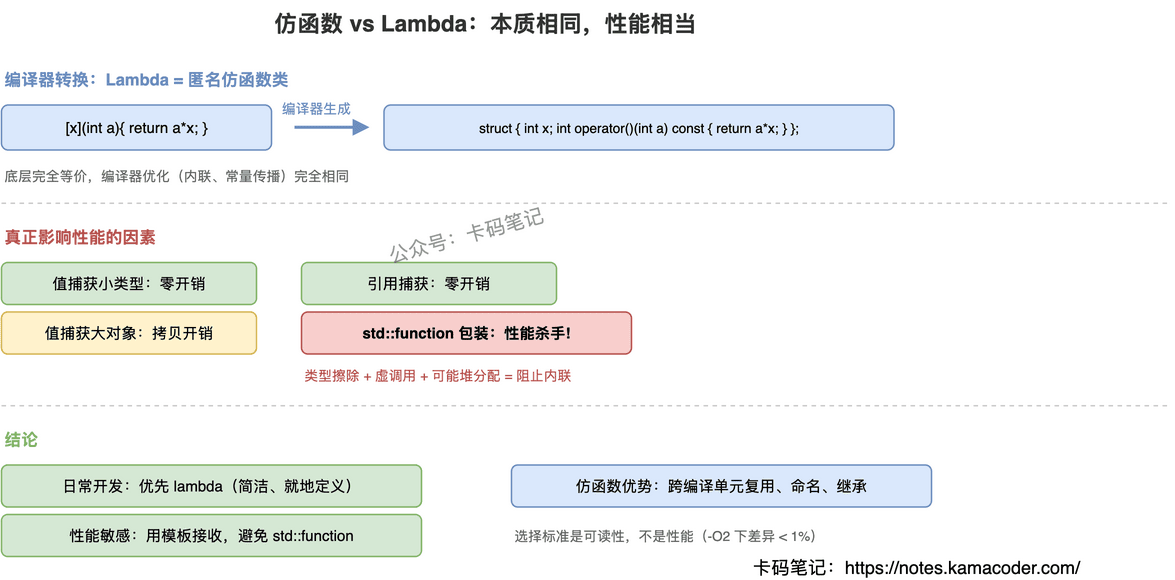
性能基本相当。因为编译器会把 lambda 表达式转换成一个匿名的仿函数类——有 operator() 的结构体。捕获的变量变成这个结构体的成员。所以从编译器的视角看,lambda 和手写仿函数没有本质区别,都能被内联优化。
在 -O2/-O3 优化级别下,两者的性能差异通常小于 1%,可以忽略。
# 详细回答
Lambda 的编译器转换
当你写 [x](int a) { return a * x; } 时,编译器实际生成的是:
struct __anonymous {
    int x;
    int operator()(int a) const { return a * x; }
};
2
3
4
然后用捕获的 x 初始化这个结构体。所以 lambda 和仿函数在底层是同一个东西——编译器对它们做的优化(内联、常量传播等)完全一样。
真正影响性能的因素
不是"用 lambda 还是仿函数",而是:
- 捕获方式:值捕获会拷贝对象到 lambda 内部(如果捕获的是大对象,开销不可忽略);引用捕获零开销但有悬垂风险
- 是否通过
std::function包装:std::function是类型擦除的容器,会引入虚函数调用或堆分配,阻止内联——这才是真正的性能杀手 - 模板 vs 类型擦除:STL 算法接受模板参数,lambda/仿函数都能被内联;但如果通过
std::function传递,就丧失了内联机会
仿函数仍有优势的场景
- 需要在多个编译单元间共享同一个可调用对象
- 需要命名(lambda 是匿名的,调试时看不到名字)
- 需要继承或多态行为
- 需要显式控制特殊成员函数(拷贝、移动)
# 知识拓展
面试官可能追问:
Q1: 捕获方式对性能有什么影响?
值捕获([x]):把变量拷贝一份存到 lambda 内部。如果是 int 这种小类型,零开销;如果是 string 或 vector,拷贝代价大。引用捕获([&x]):只存一个指针/引用,零拷贝开销,但要注意生命周期——如果 lambda 比被捕获的变量活得久,引用就悬空了。C++14 的移动捕获([x = std::move(obj)])可以避免拷贝大对象。
Q2: std::function 为什么慢?
std::function 是类型擦除的通用可调用对象容器。它内部用虚函数或函数指针实现多态调用,编译器无法内联。而且如果 lambda 捕获的数据超过一定大小(通常 16~32 字节),std::function 会在堆上分配内存。所以在性能敏感的热路径上,不要用 std::function 传递 lambda——直接用模板参数接收。
Q3: lambda 能完全替代仿函数吗?
日常开发中 99% 的场景可以。lambda 更简洁、就地定义、不需要额外命名。但仿函数在需要跨编译单元复用、需要继承体系、需要精细控制对象语义时仍有价值。选择标准是可读性和维护性,不是性能。
Q4: 函数指针和 lambda 有什么区别?
无捕获的 lambda 可以隐式转换为函数指针(因为它没有状态,等价于普通函数)。但有捕获的 lambda 不能转为函数指针——因为它有状态(成员变量),需要一个对象来承载。这也是为什么 C 风格回调接口通常需要一个额外的 void* userdata 参数来传递上下文。
评论
验证登录状态...